


Address:
WGF9+89P 2nd Floor, 9th Main Road, Ideal Homes Township, above Maharaja Vadapav, Remco Bhel Layout, Javarandoddi, Rajarajeshwari Nagar, Bengaluru, Karnataka 560098
Venue:
Upasana - Culture, Community and Wellness Space
Date:
Friday, 2 October 2026
Price:
₹1149
About Event
Vatsalya: The Dance of Connection, The Art of Parenting – Bharatanatyam & Dance Movement Therapy Workshop
About the Event
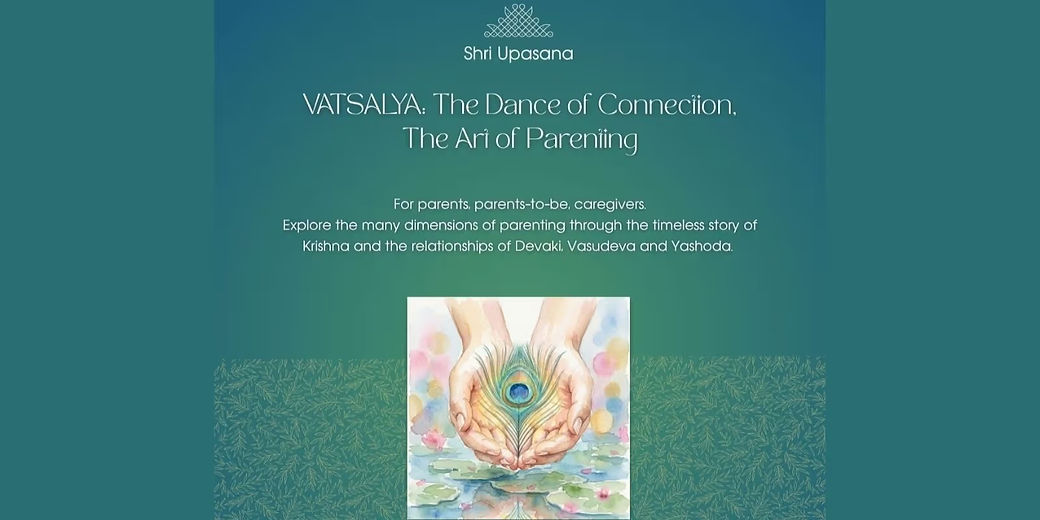
Vatsalya: The Dance of Connection, The Art of Parenting is an experiential Dance Movement Therapy (DMT) workshop inspired by Bharatanatyam, exploring the many dimensions of parenting through movement, rhythm, abhinaya, storytelling, and reflective practices.
Inspired by the timeless story of Krishna and his relationships with Devaki, Vasudeva, and Yashoda, the workshop journeys through three distinct yet interconnected experiences of parenthood.
Through these stories, Vatsalya creates a space to reflect on the emotional and relational realities of parenting. Devaki and Vasudeva represent parents who love deeply while facing circumstances beyond their control, bringing themes of anxiety, fear, sacrifice, and difficult choices into focus. Yashoda brings participants into the world of everyday parenting, with its experiences of nurturing, protecting, setting boundaries, finding joy, and learning to let a child grow while still holding them close.
The workshop uses these stories as a mirror for contemporary parenting questions:
How do we parent when we cannot control the world around our child?
How do fear and expectations influence our parenting?
When do we protect, and when do we let go?
How can we truly connect with our child rather than simply manage them?
Using the expressive vocabulary of Bharatanatyam and the embodied approach of Dance Movement Therapy, participants are invited to move beyond the question:
“What should I do as a parent?”
and towards:
“How am I showing up in my relationship with my child?”
Ultimately, Vatsalya explores parenting as a dynamic dance between holding and letting go, protection and freedom, expectation and acceptance, and love and connection.
Exploring Parenthood Through Krishna's Story
The story of Krishna offers a powerful framework for exploring different dimensions of the parent-child relationship.
Rather than presenting one fixed model of parenting, the workshop looks at three interconnected experiences through Devaki, Vasudeva, and Yashoda.
Their relationships with Krishna provide different perspectives on love, responsibility, uncertainty, protection, attachment, boundaries, and the process of letting go.
Through storytelling and embodied practices, these experiences become points of reflection for participants considering their own parenting journeys.
Devaki and Vasudeva – Love in the Face of Uncertainty
Devaki and Vasudeva represent the experience of loving a child while being confronted with circumstances beyond one's control.
Their story brings attention to the anxieties, fears, sacrifices, and difficult choices that can accompany parenthood.
Contemporary parents may also encounter situations where they cannot completely control their child's environment, experiences, or future. This can give rise to fear, uncertainty, and a strong desire to protect.
The workshop uses the experiences of Devaki and Vasudeva to encourage participants to reflect on these emotions and on the ways in which fear and circumstances can influence parenting responses.
Yashoda – The Everyday Experience of Parenting
The relationship between Yashoda and Krishna offers another perspective: the everyday world of parenting.
Yashoda brings themes of nurturing, protection, boundaries, joy, and attachment into the experience.
Everyday parenting involves not only caring for a child but also helping them gradually develop independence. Parents often have to balance the instinct to protect with the need to allow their children room to grow.
Through Yashoda's experience, participants are invited to explore this balance and reflect on what it means to hold a child close while also learning when to let go.
Parenting as a Dance Between Opposites
At the heart of Vatsalya is the idea that parenting can involve holding multiple seemingly opposite experiences at once.
The workshop explores:
Holding and letting go
Protection and freedom
Expectation and acceptance
Love and connection
These themes reflect the changing nature of parenthood, where a parent's response may need to shift depending on circumstances and the child's evolving needs.
The workshop invites participants to explore these tensions through movement and reflection rather than searching for a single universal answer.
Bharatanatyam as an Expressive Language
Bharatanatyam provides an important expressive foundation for the workshop.
Through movement, rhythm, and abhinaya, the classical dance form offers ways of communicating emotions, relationships, stories, and experiences through the body.
In Vatsalya, Bharatanatyam becomes part of an experiential process that allows participants to engage with parenting themes through embodied expression.
The focus is not simply on dance technique. Instead, the expressive vocabulary of Bharatanatyam is used as a medium for exploring relationships and emotional experiences.
Dance Movement Therapy and Embodied Exploration
The workshop also incorporates the embodied approach of Dance Movement Therapy (DMT).
Rather than relying only on verbal discussion, DMT-based exploration can involve movement, awareness, reflection, and attention to embodied experience.
Within Vatsalya, this approach is combined with Bharatanatyam-inspired expression, storytelling, rhythm, and reflective practices to create an experiential exploration of parenting.
Participants are encouraged to notice their emotional responses and consider how these responses may shape their interactions within the parent-child relationship.
Moving Beyond “What Should I Do as a Parent?”
Parenting is often discussed in terms of strategies, behaviours, and decisions.
What should I say?
What boundary should I set?
When should I intervene?
When should I step back?
Vatsalya introduces another dimension to these questions by inviting participants to explore their own presence within the relationship.
The workshop shifts attention towards:
How am I showing up?
What emotions are influencing my responses?
What expectations am I carrying?
How does fear affect the way I parent?
Am I trying to connect with my child or simply manage them?
This shift from action to awareness is a central part of the workshop.
Connection Rather Than Management
One of the workshop's key themes is the importance of exploring connection within the parent-child relationship.
Parenting naturally involves responsibilities such as setting boundaries, protecting children, and making decisions. At the same time, a relationship also involves presence, empathy, acceptance, and emotional connection.
Vatsalya creates an opportunity to reflect on how these dimensions coexist.
Participants can explore ways of understanding their own responses and becoming more aware of how they relate to their children during moments of uncertainty, conflict, protection, expectation, or change.
Questions for Contemporary Parents
The workshop uses Krishna's story to create space for reflection around questions that many parents may encounter.
How do we parent when we cannot control the world around our child?
How do fear and expectations influence our parenting?
When do we protect, and when do we let go?
How can we truly connect with our child rather than simply manage them?
These questions provide a framework for exploring parenting patterns and emotional responses through movement and reflective practices.
Goals of the Workshop
The goal of Vatsalya is to explore parenting through the embodied language of Bharatanatyam and Dance Movement Therapy.
Using the contrasting experiences of Devaki, Vasudeva, and Yashoda, the workshop examines themes such as:
Attachment
Protection
Control
Expectations
Boundaries
Autonomy
Letting go
The workshop encourages participants to engage with these themes experientially through movement, storytelling, rhythm, abhinaya, and reflection.
Outcomes of the Workshop
Participants can develop greater awareness of their parenting patterns, emotional responses, and relationship with their child through the workshop experience.
The session also introduces movement-based tools for cultivating:
Connection
Empathy
Presence
Conscious responding
The focus is on increasing awareness and creating opportunities for participants to reflect on how they experience and respond within their parenting relationships.
A Journey Through Attachment and Autonomy
Parent-child relationships can involve a constant negotiation between closeness and independence.
Attachment can create a strong desire to keep a child safe and connected, while autonomy requires children to gradually develop their own independence.
Vatsalya explores this relationship through the contrasting experiences of Krishna with Devaki, Vasudeva, and Yashoda.
The workshop provides a space to consider how parents experience attachment, protection, boundaries, and the gradual process of letting go.
Exploring Fear and Expectations
Fear can influence the way parents respond to situations involving their children.
Expectations can also shape how parents interpret their child's behaviour, choices, and development.
The workshop encourages participants to become more aware of these influences rather than simply reacting to them.
Through embodied exploration, participants can reflect on how fear, expectations, and the desire for control may appear in their own parenting experiences.
The Balance Between Protection and Freedom
Protecting a child and allowing them freedom can sometimes feel like competing responsibilities.
Parents may want to prevent difficulties or risks while also recognising that children need opportunities to develop autonomy.
Vatsalya approaches this tension as an ongoing part of parenting rather than a question with one fixed solution.
Through movement and reflection, participants are encouraged to explore their own relationship with protection, boundaries, freedom, and letting go.
The Role of Presence and Conscious Responding
The workshop places emphasis on presence and conscious responding.
Rather than automatically reacting to every situation, participants are invited to become more aware of their emotional responses and the way they show up within the parent-child relationship.
This approach is connected to the workshop's broader emphasis on moving from “What should I do?” towards “How am I showing up?”
Who Can Attend?
Vatsalya is open to all, particularly people interested in exploring parenting.
The session is preferably for participants aged 25 years and above.
Participants can attend with or without previous experience of dance.
No prior Bharatanatyam or dance experience is specified as a requirement for participation.
The workshop is intended for those who are interested in parenting, relationships, movement, embodied exploration, and reflective practices.
No Prior Dance Experience Required
Participants do not need to consider themselves dancers to engage with the workshop.
The experience uses movement as an exploratory and expressive medium rather than focusing solely on technical dance performance.
This makes the session accessible to people who are curious about Bharatanatyam and DMT but may not have previous training in either.
Facilitated By
Dr. Dhruva Ithal
Dr. Dhruva Ithal is a Psychiatrist and Bharatanatyam Dancer.
His background brings together psychiatry and classical dance within the workshop's exploration of parenting, embodiment, and relationships.
Pratima Pandurangi
Pratima Pandurangi is a Bharatanatyam Dancer and Certified DMT Practitioner.
Her experience with Bharatanatyam and Dance Movement Therapy contributes to the workshop's embodied approach.
Together, the facilitators guide participants through an experiential exploration combining dance, movement, storytelling, and reflection.
A Gentle Note About the Workshop
This session is designed as an experiential and educational introduction.
It is not intended as a substitute for long-term clinical psychotherapy.
Participants seeking deeper, personalised somatic or psychological work are welcome to continue exploring therapeutic journeys with the therapists following the workshop.
The workshop therefore serves as an experiential introduction rather than a replacement for ongoing, individualised clinical psychotherapy.
Event Terms & Conditions
Ticket Acceptance
By accepting, holding, or using a ticket, the ticket holder acknowledges that they have read, understood, accepted, and agreed to the full terms and conditions of the event.
Right of Admission
The organiser reserves the right of admission.
The organiser may also alter the event schedule without prior notice.
Entry and Security
Entry is permitted only after a thorough security check and through designated entrances.
Re-entry is not permitted once a ticket holder has exited the venue.
Security personnel may search ticket holders and their belongings at entry.
Prohibited Items
The venue does not allow the following inside the venue or seating area:
Food
Beverages
Liquids
Bottles
Cans
Tins
Bags
Lighters
Matchboxes
Flammable items
Illegal or hazardous substances
These are collectively referred to as “Prohibited Items.”
If a ticket holder refuses a security search and/or is found in possession of Prohibited Items, the organiser may deny entry without any refund or compensation.
Drug-Free Event
This is a drug-free event.
If any ticket holder uses, possesses, procures, supplies, or consumes drugs, narcotics, or psychotropic substances as defined under the Narcotic Drugs and Psychotropic Substances Act, 1985, the organiser may immediately evict them from the venue without refund or compensation.
The organiser also reserves the right to initiate legal action as permitted under applicable law.
Conduct and Behaviour
The organiser reserves the right to refuse admission or eject any ticket holder who appears intoxicated, is under the influence of drugs, behaves dangerously or inappropriately, or engages in conduct likely to cause harassment, damage, injury, or nuisance.
The organiser's decision in this regard shall be final.
Photography and Recording
The use of audio or video recording equipment, including still cameras, is strictly prohibited.
Attendees are required to comply with the applicable event and venue restrictions regarding recording.
Ticket Rules
The organiser issues tickets in accordance with the rules and regulations of the event organiser and venue management.
The organiser and venue are not liable for issues arising from unauthorised copies or reproductions of tickets.
The ticket is invalid if the security features affixed to it are tampered with.
Refund and Cancellation Policy
Except as specifically stated in the applicable terms, a ticket is non-refundable and cannot be exchanged, cancelled, or returned once purchased.
If the organiser cancels the performance, the organiser will refund the ticket fee.
All other charges, including parking fees, internet handling fees, and order processing fees, remain non-refundable.
Personal Safety and Property
The organiser does not accept responsibility for any injury to persons or for any loss or damage to personal property brought to the event.
Attendees are responsible for their personal belongings and are expected to follow applicable safety and venue instructions.
Alcohol Regulations
In accordance with applicable law, persons below the legally permissible age may not purchase or consume alcoholic beverages.
All attendees must comply with applicable legal and venue requirements concerning alcoholic beverages.
Communicable Disease Risk
Attendees voluntarily assume all risks related to contracting COVID-19, H1N1, or any other communicable disease or illness, whether occurring before, during, or after the event, and waive all claims against the organiser arising from such risks.
Force Majeure
The event is subject to force majeure conditions.
Circumstances beyond the organiser's reasonable control may affect the event schedule or arrangements.
Cooperation
All attendees are requested to cooperate with the organiser and venue management at all times.
Guests are expected to follow reasonable instructions provided by the organiser, venue representatives, and security personnel.
Event Changes and Lineup
The organiser may modify these terms and conditions at its discretion from time to time.
Any secondary performances, if applicable, and the event lineup are subject to the artist's discretion.
The organiser may also alter the event schedule without prior notice.
Personal Information and Privacy
To ensure a high-quality user experience, the organiser may collect certain information during booking, registration, or payment.
This may include personally identifiable information such as:
Name
Email address
Phone number
Such information may be collected in accordance with the applicable Terms and Conditions and Privacy Policy.
Jurisdiction
All disputes or claims relating to the event shall be subject to the exclusive jurisdiction of the courts in Mumbai.
Experience Vatsalya
Vatsalya: The Dance of Connection, The Art of Parenting offers an experiential exploration of parenting through the meeting point of Bharatanatyam, Dance Movement Therapy, storytelling, rhythm, abhinaya, and reflective practices.
Through the relationships of Devaki, Vasudeva, and Yashoda with Krishna, participants are invited to explore attachment, fear, protection, boundaries, autonomy, expectations, acceptance, and the process of letting go.
The workshop shifts the focus from simply asking what a parent should do towards examining how a parent is showing up within the relationship with their child.
It creates a space to reflect on the balance between holding and letting go, protection and freedom, expectation and acceptance, and love and connection.
Come explore parenting through movement, story, and embodied reflection—and discover the dance of connection within the art of parenting.
View location on Maps: