


Address:
3rd Floor, No, 421/J, Shri Krishna Temple Rd, Indira Nagar 1st Stage, Stage 1, Indiranagar, Bengaluru, Karnataka 560038
Venue:
Dongle Desk Cafe, Bengaluru, Bangalore
Date:
Sunday, 27 September 2026
Price:
₹2994
About Event
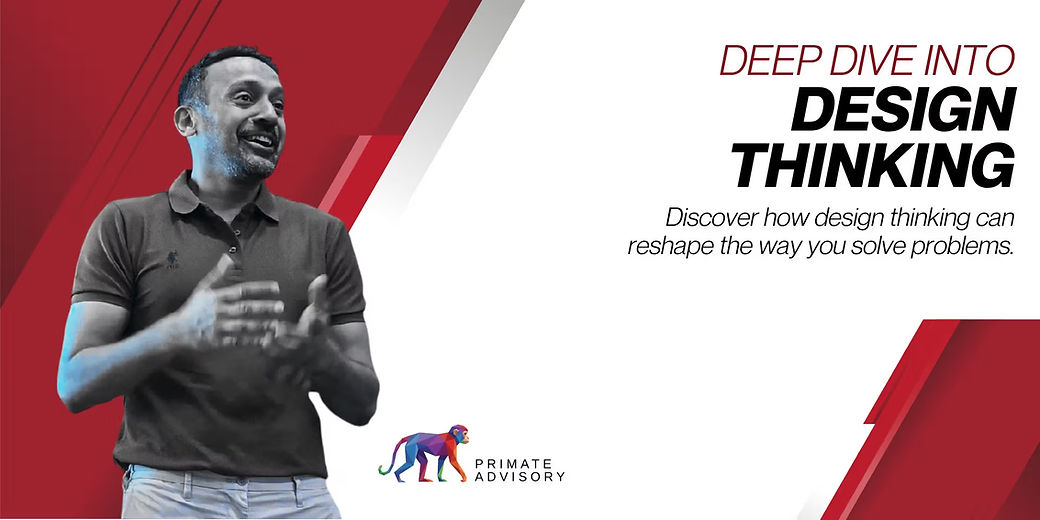
Design Thinking Workshop – Learn Human-Centred Problem Solving with Vishal Mimani
About the Event
Discover the Power of Design Thinking
Design Thinking is a human-centred, iterative approach to problem-solving that brings together user desirability, technological feasibility and business viability.
Instead of beginning with the question of what product should be built, Design Thinking encourages participants to first understand the real needs, experiences and challenges of users.
This interactive workshop is designed for anyone interested in understanding and applying the principles of Design Thinking in practical situations.
Whether you are an entrepreneur, student, working professional or simply curious about innovation, the session is designed to provide practical tools, real-world examples and hands-on experience that can help you approach challenges from a user-centric perspective.
The workshop introduces the five core phases of Design Thinking:
Empathize → Define → Ideate → Prototype → Test
Through these stages, participants will explore how structured thinking, experimentation and user understanding can contribute to solving complex problems.
What Is Design Thinking?
Design Thinking is an approach to solving problems by placing people and their needs at the centre of the process.
It balances three important considerations:
User Desirability
Does the solution address a real user need or problem?
Technological Feasibility
Can the proposed solution realistically be developed using available or appropriate technology?
Business Viability
Can the solution work within a sustainable business or organisational context?
By considering these dimensions together, Design Thinking encourages a more balanced approach to innovation and problem-solving.
The Five Core Phases of Design Thinking
The workshop introduces participants to the five core phases that form the Design Thinking process.
1. Empathize
The first stage focuses on understanding the people who experience the problem.
Participants learn the importance of looking closely at user needs, experiences and challenges before attempting to create solutions.
The objective is to build a deeper understanding of the user rather than making assumptions about what they need.
2. Define
Once user insights have been gathered, the next step is to clearly define the challenge.
Defining the problem helps turn observations and user information into a focused problem statement that can guide the rest of the process.
3. Ideate
The ideation stage is about exploring possible solutions.
Participants are encouraged to think creatively and generate multiple ideas rather than immediately settling on the first possible answer.
This stage creates space for experimentation and different perspectives.
4. Prototype
Ideas can then be translated into prototypes.
Prototyping provides a way to represent and explore potential solutions before investing heavily in development.
It can help make ideas more tangible and create opportunities to identify what works and what needs improvement.
5. Test
The final core phase involves testing solutions and learning from the results.
Testing creates an opportunity to gather feedback, identify gaps and refine the proposed solution.
The iterative nature of Design Thinking means that insights from testing can feed back into earlier stages of the process.
An Interactive Design Thinking Workshop
This is not designed as a purely theoretical session.
The workshop is described as interactive, giving participants the opportunity to engage with Design Thinking principles through practical exercises and case studies.
Participants can explore the process by applying concepts to challenges rather than only listening to explanations.
The hands-on format is intended to make the Design Thinking framework easier to understand and apply in real-world situations.
What You Will Gain
A Comprehensive Understanding of Design Thinking
Participants will develop an understanding of the overall Design Thinking process, including its five core phases and how they connect with one another.
Real-Life Examples
The workshop includes real-life examples to help demonstrate how Design Thinking principles can be applied to practical challenges.
Examples can help bridge the gap between learning a framework and understanding how it can be used in real situations.
A User-Centric Approach to Problem-Solving
Participants will learn how to approach challenges from a user-centric perspective, focusing on understanding real needs before developing solutions.
Hands-On Case Study Experience
The session includes hands-on work with case studies, giving participants an opportunity to apply concepts and explore problem-solving in practice.
Networking Opportunities
The workshop also provides an opportunity to network with like-minded individuals who are interested in innovation, problem-solving and Design Thinking.
Practical Learning Through Case Studies
One of the key components of the workshop is its hands-on approach to case studies.
Case studies can provide a practical context in which participants can explore how Design Thinking moves from understanding users to defining problems, generating ideas, developing prototypes and testing solutions.
The workshop gives participants an opportunity to engage with this process rather than simply reading about it.
Build a User-Centric Mindset
A central principle of the workshop is learning to approach challenges through the perspective of the people affected by them.
A user-centric approach encourages participants to ask questions, examine experiences and understand needs before jumping to solutions.
This shift in perspective can help participants rethink how they frame problems and evaluate possible solutions.
Design Thinking for Entrepreneurs
Entrepreneurs can use Design Thinking principles to explore customer needs and develop ideas around real problems.
The workshop provides entrepreneurs with a structured framework for approaching challenges while keeping users at the centre of the process.
Design Thinking for Students
Students interested in innovation, business, product development or creative problem-solving can use the workshop to understand a widely applicable problem-solving methodology.
The hands-on format can provide an opportunity to practise the framework rather than learning it only in theory.
Design Thinking for Professionals
Working professionals from different fields can explore Design Thinking as a framework for understanding challenges, generating ideas and approaching problems from a user-focused perspective.
The workshop is intended for anyone interested in developing practical innovation and problem-solving skills.
Design Thinking for Curious Minds
You do not need to be an entrepreneur or work in product development to explore Design Thinking.
The session is also designed for people who are simply curious about fostering innovation and want to learn a structured approach to solving problems.
The workshop provides an opportunity to understand the principles and experiment with applying them.
Workshop Takeaways
Participants will receive several takeaways from the experience.
Design Thinking Workbook
A Design Thinking Workbook is included as part of the workshop experience, providing participants with a resource to accompany their learning.
Certificate of Participation
Participants will receive a Certificate of Participation.
Access to an Exclusive Design Thinking WhatsApp Community
Participants will have the choice to join an exclusive Design Thinking WhatsApp community, providing an additional space connected to the workshop experience.
Meet the Facilitator – Vishal Mimani
The workshop is facilitated by Vishal Mimani, Partner & Chief Design Officer at Primate Advisory.
With his role in design and advisory work, Vishal brings the Design Thinking framework into the context of practical problem-solving and innovation.
His role as facilitator is to guide participants through the process and help them engage with the principles through examples and hands-on case studies.
A Small-Group Workshop Experience
The workshop is conducted in small groups.
This format is intended to support interactive participation and hands-on engagement during the session.
Registrations are dependent on participant sign-ups, so the final group composition may depend on the number of participants registered for the workshop.
Workshop Location
The workshop venue is located approximately a five-minute walk from Indiranagar Metro Station.
This makes the location accessible for participants using the Bengaluru Metro and those travelling through the Indiranagar area.
Parking Facilities
The venue provides parking facilities for both:
Two-wheelers
Four-wheelers
Valet parking is available for four-wheelers, as specified in the event information.
What to Expect During the Workshop
Learn
Understand the fundamentals and five stages of Design Thinking.
Observe
Explore the importance of understanding real users and their needs.
Define
Learn how to turn observations into clearly framed challenges.
Ideate
Generate multiple possible solutions and explore different perspectives.
Prototype
Experiment with ideas by creating representations of potential solutions.
Test
Understand the importance of feedback, iteration and refinement.
Apply
Work with case studies to put the framework into practice.
Connect
Meet other participants interested in innovation and user-centric problem-solving.
Why Attend a Design Thinking Workshop?
Design Thinking offers a structured way to approach complex problems without immediately jumping to a solution.
The workshop gives participants an opportunity to understand how empathy, problem definition, ideation, prototyping and testing can form a connected process.
The practical focus on examples and case studies makes the learning experience applicable beyond the workshop itself.
From Problems to Possibilities
A major idea behind Design Thinking is that meaningful solutions begin with a clear understanding of the problem.
By starting with users, defining the challenge carefully and exploring multiple possibilities, participants can learn to approach problems through a more structured and iterative process.
The workshop is designed to give attendees the tools and experience needed to explore this approach.
Event Participation Guidelines
By accepting, holding or using a ticket, attendees acknowledge that they have read, understood, accepted and agreed to the full terms and conditions.
The organiser reserves the right of admission and may alter the event schedule without prior notice.
Entry is permitted only after a thorough security check and through designated entrances.
Re-entry is not permitted.
Prohibited Items
The venue does not allow the following inside the venue or seating area:
Food
Beverages and liquids
Bottles
Cans
Tins
Bags
Lighters
Matchboxes
Flammable items
Illegal or hazardous substances
Security personnel may search ticket holders and their belongings at entry.
If a ticket holder refuses a security search or is found carrying prohibited items, the organiser may deny entry without refund or compensation.
Drug-Free Event and Conduct Rules
This is a drug-free event.
The use, possession, procurement, supply or consumption of drugs, narcotics or psychotropic substances as defined under the Narcotic Drugs and Psychotropic Substances Act, 1985, is prohibited.
Anyone found violating this rule may be immediately evicted without refund or compensation, and the organiser reserves the right to initiate legal action as permitted by applicable law.
Admission may also be refused, or an attendee may be ejected, if they appear intoxicated, are under the influence of drugs, behave dangerously or inappropriately, or engage in conduct likely to cause harassment, damage, injury or nuisance.
The organiser's decision in such matters shall be final.
Recording Policy
The use of audio or video recording equipment, including still cameras, is strictly prohibited.
Attendees must follow the recording restrictions throughout the workshop.
Ticket and Refund Policy
Tickets are issued according to the rules and regulations of the organiser and venue management.
Except as specifically stated, tickets are non-refundable and cannot be exchanged, cancelled or returned once purchased.
If the organiser cancels the performance or event, the ticket fee will be refunded.
Other charges, including parking fees, internet handling fees and order processing fees, remain non-refundable.
The organiser and venue are not liable for issues arising from unauthorised copies or reproductions of tickets.
Tickets are invalid if their security features have been tampered with.
Alcohol and Legal Requirements
In accordance with applicable law, persons below the legally permissible age may not purchase or consume alcoholic beverages.
All attendees must comply with applicable legal and venue requirements.
Personal Safety and Liability
The organiser does not accept responsibility for injury to persons or for loss of or damage to personal property brought to the event.
Attendees voluntarily assume the risks associated with COVID-19, H1N1 and other communicable diseases or illnesses, whether occurring before, during or after the event, and waive applicable claims against the organiser as stated in the event terms.
The event is also subject to force majeure conditions.
Attendees are requested to cooperate with the organiser and venue management at all times.
Event Changes and Participation
The organiser may modify the terms and conditions at its discretion from time to time.
The event schedule may also be altered without prior notice.
As this is a small-group workshop, registrations depend on participant sign-ups, and the session format may therefore depend on the final number of participants.
Personal Information and Privacy
To provide a high-quality user experience, the organiser may collect information during booking, registration or payment.
This may include personally identifiable information such as:
Name
Email address
Phone number
Such information may be collected in accordance with the applicable Terms and Conditions and Privacy Policy.
Jurisdiction
All disputes or claims relating to the event shall be subject to the exclusive jurisdiction of the courts in Mumbai, as specified in the event terms and conditions.
Experience Design Thinking in Practice
This Design Thinking Workshop offers an interactive introduction to human-centred problem-solving through a structured process of Empathize, Define, Ideate, Prototype and Test.
Participants will explore how user desirability, technological feasibility and business viability can work together to inform solutions.
The session includes real-life examples, hands-on case studies, practical tools and networking opportunities, making it suitable for entrepreneurs, students, professionals and anyone interested in innovation.
Facilitated by Vishal Mimani, Partner & Chief Design Officer at Primate Advisory, the workshop is conducted in small groups, with registrations dependent on participant sign-ups.
Participants will receive a Design Thinking Workbook and Certificate of Participation, along with the choice to join an exclusive Design Thinking WhatsApp community.
Located approximately five minutes from Indiranagar Metro Station, the venue also offers two-wheeler parking and four-wheeler valet parking.
Understand the problem. Put users first. Explore possibilities. Learn by doing.
Discover Design Thinking through a practical, interactive workshop.
View location on Maps: